

The Structural Logic of American Military Power
Publikasi Terbaru
Selasa, 31 Maret 2026
Selasa, 31 Maret 2026

Senin, 30 Maret 2026
250 Years of Operations Against Sovereign States—and What They Reveal About the Coming Era
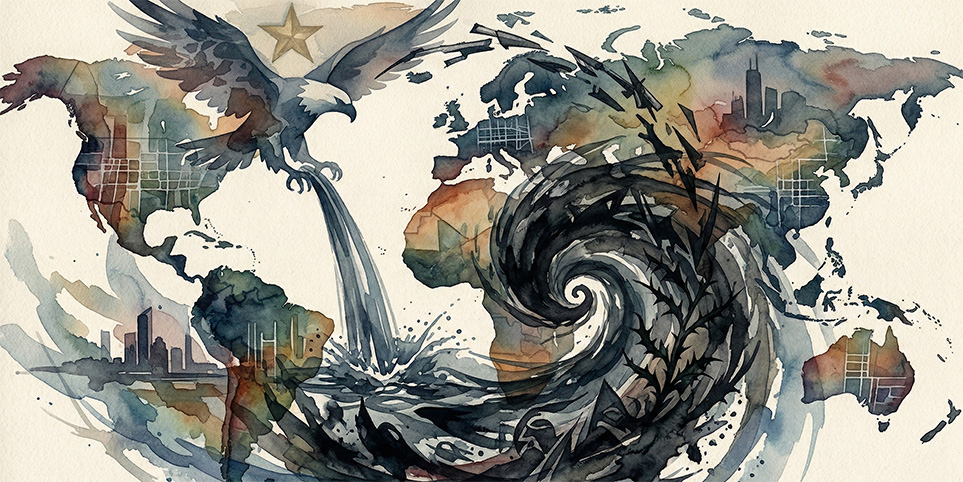
Since the founding of the republic, the United States has conducted more than 247 documented military operations against sovereign states. It has formally declared war exactly five times. The gap between these two figures—a ratio of roughly fifty to one—is not an anomaly or an oversight. It is the defining structural feature of American military power: a two-and-a-half-century pattern of force projection that operates almost entirely outside the constitutional framework ostensibly designed to govern it. To understand why the United States fights, where it fights, and how it fights, one must look not to the rhetoric of individual presidents or the vagaries of electoral politics but to the deeper structural imperatives of great power competition in an anarchic international system.
That, at least, is the argument that John Mearsheimer advanced in The Tragedy of Great Power Politics, and it remains the most parsimonious explanation for the full arc of American military activism. Mearsheimer’s offensive realism posits that great powers are condemned by the structure of the international system to maximize their relative power. Because states can never be certain of one another’s intentions, and because no world government exists to enforce agreements, the only reliable guarantee of survival is preponderance—ideally, regional hegemony combined with the capacity to prevent any rival from achieving hegemony elsewhere. By this logic, every major phase of American military operations, from the Barbary Wars to the January 2026 capture of Nicolás Maduro in Caracas, follows a single structural imperative: the maintenance of primacy.
The quantitative record bears this out with striking clarity. The Cold War era alone produced 97 documented operations—nearly forty percent of the historical total—as bipolar competition drove the United States into covert and overt interventions across every continent. Lindsey O’Rourke’s pathbreaking research identified 64 covert regime change attempts between 1947 and 1989, compared to just six overt military interventions—a ratio of more than ten to one. Dov Levin documented American intervention in 81 foreign elections during roughly the same period. The geographic distribution of these operations tracks Mearsheimer’s theoretical predictions with remarkable precision: Latin America and the Caribbean accounted for nearly 39 percent of all interventions, reflecting Monroe Doctrine enforcement; the Middle East and North Africa for 21 percent, reflecting oil dependency and the prevention of regional hegemony; and East and Southeast Asia for 15 percent, reflecting the containment of Chinese and Soviet influence.
What is most revealing, however, is not the sheer volume of Cold War interventions but the structural pattern that connects them to what came before and after. The covert-to-overt ratio shifts predictably with systemic polarity. During bipolarity, nuclear deterrence made direct confrontation between superpowers prohibitively dangerous, channeling competition into covert action and proxy warfare. When the Soviet Union collapsed and unipolarity emerged, the ratio reversed: the United States shifted to overt military action—the Gulf War, Bosnia, Kosovo—because the absence of a balancing power reduced the costs of visible intervention. The post-2001 era has been predominantly overt, though the 2020s are producing a hybrid model that combines surgical overt strikes with covert pre-positioning, as the Venezuela operation demonstrated. This oscillation is not a function of presidential temperament. It is structurally determined.
Graham Allison’s Thucydides Trap framework sharpens the analysis. Allison identified sixteen cases over the past five centuries in which a rising power threatened to displace a ruling power; twelve ended in war. The critical insight for understanding American military operations is that the United States does not simply fight rising challengers directly. It fights in peripheral theaters to secure its position for the main competition. Operations peak during periods of structural anxiety—when a rival power’s trajectory threatens to alter the balance—even when the target states are not the rivals themselves. The early Cold War, when the Soviet Union was rising most rapidly, produced the highest operational tempo in American history: 35 operations between 1947 and 1962, including the Korean War, eighteen or more covert regime changes, and the Cuban Missile Crisis. Most of these targets—Iran, Guatemala, Indonesia, the Congo—posed no direct threat to American survival. They mattered because their alignment could tip the broader balance.
The same logic applies today. The 2025–2026 operations against Iran and Venezuela are not, in structural terms, about nuclear nonproliferation or narco-terrorism, whatever the stated justifications. They are about a hegemon that perceives its relative power declining vis-à-vis China and is moving aggressively to secure its regional base and eliminate potential footholds for extra-hemispheric rivals. With the United States at roughly 37 percent of composite global power and China at 35 percent—near-parity by any serious measure—the structural pressures toward intervention are at their highest level since the early Cold War.
Operation Midnight Hammer, the June 2025 strikes against Iran’s nuclear facilities, illustrates the preventive war logic that Allison warned about. One hundred and twenty-five aircraft, including seven B-2 stealth bombers carrying the GBU-57 Massive Ordnance Penetrator for the first time in combat, struck Fordow, Natanz, and Isfahan in a twenty-five-minute window. The Pentagon claimed the strikes set Iran’s nuclear program back two years. Yet by February 2026, a second wave of American and Israeli strikes was underway across six Iranian cities, and the administration’s own envoy acknowledged that Iran might be “a week away from industrial-grade bomb-making material”—directly contradicting eight months of claims that the program had been obliterated. The International Atomic Energy Agency confirmed that enriched uranium remained “in large quantities.”
This is Mearsheimer’s tragedy in miniature. The strikes were a rational response to a genuine structural threat: no great power can tolerate a potential nuclear peer in a region vital to its interests. But the security dilemma ensures that the strikes themselves generate the very insecurity they were designed to prevent. Iran retaliated against Al Udeid Air Base in Qatar and, eight months later, against the Fifth Fleet headquarters in Bahrain. The escalatory spiral—strikes, retaliation, further strikes—is not a failure of diplomacy or an absence of strategic thinking. It is the predictable consequence of security-maximizing behavior in an anarchic system.
The Venezuela operation is structurally distinct but theoretically complementary. On January 3, 2026, approximately two hundred Special Operations Forces, led by a Delta Force assault element, captured President Maduro and his wife from a compound in Caracas in a two-and-a-half-hour raid launched from the USS Iwo Jima. It was, as the historian Alan McPherson observed, the first time the United States had directly intervened in South America to effect regime change—previous direct actions had been confined to Central America and the Caribbean. The operation was preceded by four months of escalating strikes on Venezuelan vessels, oil tanker seizures, CIA land strikes, and a formal naval blockade. Maduro was arraigned in a Manhattan federal court two days later and declared himself a prisoner of war.
The framing of the operation as “law enforcement” rather than “invasion” mirrors two centuries of justification inflation. Each era of American military activism has produced new rhetorical frameworks to legitimate the use of force: commerce protection gave way to the Monroe Doctrine, which gave way to anti-imperialism, collective security, anti-communism, humanitarian intervention, counterterrorism, counter-narcotics, and now preemptive nonproliferation. From an offensive realist perspective, these justifications are epiphenomenal. The structural imperative is always security maximization. Venezuela under Maduro maintained security relationships with Russia, China, Iran, and Cuba—precisely the kind of extra-hemispheric presence that a regional hegemon cannot tolerate. The “Donroe Doctrine,” as observers have dubbed the administration’s approach, echoes the Monroe Doctrine’s original purpose with unsettling fidelity.
The question that haunts both operations is whether they represent strategic adaptation or accelerated decline. Paul Kennedy’s thesis on imperial overstretch—that great powers fall when their military commitments outstrip their economic base—casts a long shadow over the post-2001 trajectory. The United States has spent more than eight trillion dollars on the War on Terror. It maintains over 750 military bases in 80 countries. Its national debt exceeds 36 trillion dollars, surpassing Second World War ratios. It is simultaneously engaged in seven or more active theaters. All of this has occurred while China’s GDP grew from 1.3 trillion dollars in 2001 to approximately 18 trillion in 2025.
The 2025–2026 pivot to what might be called “surgical interventionism”—capturing a head of state in a three-hour raid rather than occupying a country for two decades—may represent a genuine adaptation to Kennedy’s overstretch constraint. The Venezuela operation cost approximately twenty million dollars per day at peak naval operations, a fraction of the Iraq War’s expenditure. The Iran strikes involved a single night of precision bombing rather than an open-ended ground campaign. Whether this lighter footprint avoids the debilitating costs that sapped American power after 2001, or merely changes the form of overstretch while preserving its substance, is the central strategic question of the current era.
The most consistent finding across 247 operations and 250 years is the one that Mearsheimer placed at the center of his work: the tragedy. Military interventions designed to enhance American security have, with disconcerting regularity, generated the threats they were intended to prevent. The Central Intelligence Agency’s support for the Afghan mujahideen produced al-Qaeda. The restoration of the Shah produced the Iranian Revolution. The invasion of Iraq produced the Islamic State and empowered the very Iranian nuclear program that the United States struck in June 2025. The destruction of the Libyan state produced a weapons bazaar that armed insurgencies across the Sahel. The pattern is not a series of mistakes by incompetent policymakers. It is the security dilemma operating at civilizational scale: rational, security-maximizing behavior by a great power creates counter-reactions that leave it no more secure, and often less so.
Whether the 2025–2026 operations will reproduce this pattern is not yet knowable. What is knowable is that the structural conditions that have driven American military activism for two and a half centuries—the anarchic international system, the imperative of hegemonic maintenance, the security dilemma—remain fully intact. The power gap between the United States and China is narrowing to a degree not seen since the Soviet Union achieved nuclear parity in the late 1960s. The operations in Iran and Venezuela are consistent with the historical pattern: when the gap narrows, the hegemon secures its regional base and strikes at potential nuclear peers in secondary theaters where it retains escalation dominance. The tragedy of great power politics is not that states make irrational choices. It is that the rational choices available to them are, in the final analysis, insufficient to escape the structural trap in which they find themselves. Two hundred and fifty years of American military history suggest that this trap has no exit.
REFERENCES
Allison, Graham. Destined for War: Can America and China Escape Thucydides’s Trap? Boston: Houghton Mifflin Harcourt, 2017.
Congressional Research Service. Reports R42738 and RL30172, Instances of Use of United States Armed Forces Abroad, 1798–2024. Washington, D.C.: CRS, 2024.
Kennedy, Paul. The Rise and Fall of the Great Powers. New York: Random House, 1987.
Levin, Dov H. “When the Great Power Gets a Vote.” International Studies Quarterly 60, no. 2 (2016): 189–202.
Mearsheimer, John J. The Tragedy of Great Power Politics. Updated ed. New York: W. W. Norton, 2014.
O’Rourke, Lindsey A. Covert Regime Change: America’s Secret Cold War. Ithaca, N.Y.: Cornell University Press, 2018.
Watson Institute, Brown University. “Costs of War” project, updated 2024.