

Informal Empire and the U.S.-Indonesia Trade Deal
Publikasi Terbaru
Selasa, 31 Maret 2026

Selasa, 31 Maret 2026

Senin, 30 Maret 2026
Politik Keamanan
Ekonomi Politik
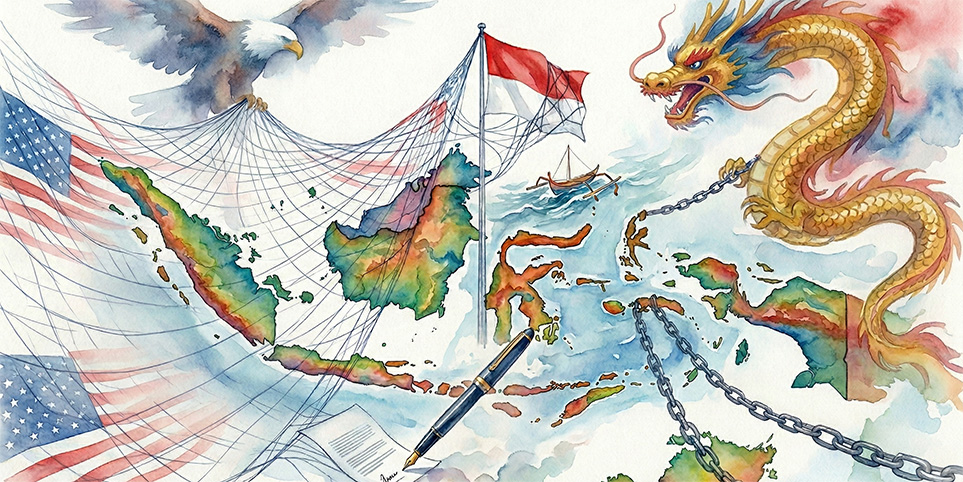
On February 19, 2026, the White House published a document with a striking title: “Implementation of the Agreement Toward a NEW GOLDEN AGE for the U.S.-Indonesian Alliance.” The word alliance leapt off the page. Indonesia—the world’s fourth most populous country, a founding member of the Non-Aligned Movement, and a state that has carefully guarded its strategic autonomy for over seven decades—was suddenly being described in the language of formal alignment. The occasion was not a mutual defense treaty or a joint command structure. It was a trade deal.
The Agreement on Reciprocal Trade (ART) between the United States and Indonesia commits Jakarta to an extraordinary array of concessions—on tariffs, import obligations, regulatory standards, intellectual property, labor law, export controls, telecommunications security, and the alignment of its border measures with future U.S. trade restrictions on third countries. In exchange, Washington sets a 19 percent ceiling tariff for all Indonesian goods, while granting zero tariff treatment for 1.890 listed goods, primarily in the agriculture and textile sectors.
Regardless of what Indonesia gains from the deal, it reveals the asymmetric nature of the arrangement where obligations flow overwhelmingly in one direction. Indonesia must accept U.S. standards for food safety, pharmaceuticals, medical devices, and motor vehicles. It must exempt U.S. companies from local content requirements. It must open critical minerals, energy, telecommunications, and financial services to American investment without ownership restrictions. It must adopt measures “with equivalent restrictive effect” when the United States imposes trade restrictions on third countries for national security reasons. Meanwhile, Washington retains the unilateral right to reimpose the original 32 percent tariff if Indonesia enters a free trade agreement that “jeopardizes essential U.S. interests.”
The arrangement cannot be understood as merely a conventional economic trade deal, given its unusual demand for geopolitical and strategic alignment. Yet the ART is also not a form of an alliance pact. Rather, this deal reveals the architecture of informal empire—a relationship in which sovereignty remains formally intact while policy autonomy is progressively narrowed through asymmetric dependence and externally imposed rule-taking. It entails binding obligations of alignment without any of its benefits—no mutual defense guarantee, no privileged technology transfer, no seat in the coalitions shaping the strategic future. And the manner in which this agreement came about—driven by the personal diplomatic inclinations of a single leader rather than institutional deliberation—has now been locked into a binding international agreement that will constrain Indonesian policy long after the personal rapport that facilitated it has faded.
The Imperialism of Free Trade, Revisited
The concept of informal empire is not new. In 1953, the Cambridge historians John Gallagher and Ronald Robinson published a landmark essay that transformed how scholars understood the British Empire. Their central insight was that the conventional map of empire—the territories “coloured red”—captured only a fraction of Britain’s actual influence. Beneath formal dominion lay a vast infrastructure of commercial penetration, treaty obligations, and political leverage that shaped the policies of nominally sovereign states from Argentina to the Ottoman Empire.
Gallagher and Robinson argued that British policy followed a consistent logic: extend control informally, if possible, formally if necessary. Free trade was not an alternative to empire, it was empire’s preferred instrument. Crucially, the system depended on what they called “collaborating elites”—local leaders whose personal interests aligned with integration into the imperial economic system, and who therefore accepted its terms voluntarily. Where such elites cooperated and markets remained open, gunboats and governors were unnecessary. This framework was developed to explain nineteenth-century British expansion, but its categories map onto the present more closely than is comfortable. Market access as leverage, regulatory harmonization as rule-imposition, trade conditionality as a substitute for direct political control. Where Britain used trading companies and gunboat diplomacy, the United States deploys tariff policy and executive orders. The form is different. The underlying structure is not.
Indonesia’s position becomes clearer when set alongside how the United States structures its other relationships across the Indo-Pacific. These comparisons reveal not a single model of partnership but a hierarchy of alignment—one in which the label Washington attaches to a given relationship tells you surprisingly little about what the partner actually gets.
Consider the Philippines. Manila has a mutual defense treaty with Washington dating to 1951, deepened through expanded basing arrangements since 2023. In 2025, the United States approved a five-and-a-half billion dollar sale of F-16 fighter jets. The Philippine Enhanced Resilience Act, passed in the 2026 National Defense Authorization Act, authorizes two and a half billion dollars in security assistance over five years—the most intensive American defense investment in the Philippines since the Cold War. Over 500 joint military activities were approved for 2026, including the annual Balikatan exercises. Manila receives weapons systems, training, intelligence sharing, and a credible extended deterrent against Chinese encroachment in the South China Sea. This is recognizably an alliance. Obligations flow in both directions, and the weaker partner receives tangible capability in return for its commitments.
Or consider India, which formally joined the U.S.-led Pax Silica coalition on February 20, 2026—the very same day Indonesia signed its trade agreement. Pax Silica, launched in December 2025, is a multilateral initiative to build secure supply chains for semiconductors, critical minerals, and artificial intelligence among trusted partners. Its signatories include Australia, Japan, South Korea, the United Kingdom, Israel, Singapore, and the United Arab Emirates. India’s entry gives it a seat at the table where the next generation technology is being designed. India is not a formal treaty ally, but through Pax Silica, the bilateral Initiative on Critical and Emerging Technology, and rapidly growing defense trade, New Delhi is being drawn into the core of American technological and industrial power. India is trading some policy flexibility for genuine capability transfer and institutional inclusion in the coalitions that matter.
Indonesia’s position is nothing like either of these. It has received no comparable defense technology package, no security assistance legislation, no invitation into the semiconductor supply chain coalition. The contrast was sharpened just days before the ART was signed, when Boeing confirmed that it was abandoning the sale of 24 F-15EX fighter jets to Indonesia—a deal that had stalled for over two years without ever being formalized. Indonesia has long pursued a diversified defense procurement strategy — a legacy of past U.S. arms embargoes. Jakarta’s first Rafale deliveries in January 2026, alongside the pending realization of agreements for Turkish and South Korean fighters, reflect this established pattern rather than a sudden turn. But the pattern itself underscores the point, even as Jakarta signed its most extensive economic commitment to Washington in decades, the defense relationship remained shallow and transactional. In classical alliance theory, the deep economic and regulatory integration demanded by the ART would be accompanied by mutual defense guarantees or privileged access to advanced military technology. The ART offers neither. What Indonesia gives and what it receives are out of all proportion.
A President’s Choice, Not A Nation’s Strategy
One provision of the ART illustrates how deep the alignment runs. Article 5.2, titled “Equipment and Platform Security,” commits Indonesia to use only communication technology suppliers that “do not compromise the security, safeguards, and intellectual property of ICT infrastructure, including 5G, 6G, communication satellites, and undersea cables.” Crucially, Indonesia must “consult with the United States on which suppliers are unable to meet these standards.” Though the agreement names no specific company, the target is unmistakable: a mechanism for excluding Chinese telecommunications firms from Indonesia’s digital infrastructure, with Washington holding the veto. Similar provisions appear in the trade agreements the United States has signed with Argentina and El Salvador, both also founding members of Trump’s Board of Peace. In each case, countries entering the U.S. economic orbit accept not merely trade terms, but technology choices dictated by American strategic priorities.
The timing of the signing reinforces the point. President Prabowo traveled to Washington in mid-February to attend the inaugural Board of Peace meeting, at which Trump announced Indonesia had pledged troops to the international stabilization force for Gaza. The trade agreement was signed the following day. Board of Peace membership, troop pledges, and a sweeping trade deal all within 48 hours—the message is hard to miss. Alignment with Washington is no longer confined to trade. It now cuts across economic, diplomatic, and security dimensions at once.
Yet the depth of this alignment is not the product of institutional strategy. It appears to be driven by the personal diplomatic preferences of President Prabowo Subianto. From the decision to join the Board of Peace to the pace and scope of the trade negotiations, reports have consistently indicated that Indonesia’s professional diplomats—at the Ministry of Foreign Affairs, the Ministry of Trade, and the Ministry of Industry—were sidelined from key decisions.
Writing in Kompas shortly after the signing, Mari Elka Pangestu—Deputy Chair of the National Economic Council and Indonesia’s lead negotiator—emphasized that the agreement is a trade instrument, noting that the Indonesian side pushed to strip non-economic clauses from the ART. The implication is clear: Jakarta sought to avoid any provision that could be read domestically as a security commitment. However, the result was paradoxical. By insisting on a purely economic framing, Indonesia ensured that the agreement offers no guarantee of the strategic benefits—mutual defense commitments, privileged arms transfers, security cooperation—that might have given Jakarta something of genuine value in return for its sweeping concessions. The problem is not that Indonesia avoided a military alliance. It is that the economic obligations it accepted function as security alignment—export controls, sanctions mirroring, telecommunications vetting—without being labeled as such, so Indonesia bears the geopolitical costs of alignment without the deterrent or capability benefits that would normally accompany it.
Early in his presidency, Prabowo signaled a willingness to hedge toward Beijing — signing a joint statement with Xi Jinping that implied recognition of China’s nine-dash line in the South China Sea, joining BRICS in January 2025, and traveling to China that August to attend a PLA military parade amid nationwide protests. But since then, Prabowo has been pulled decisively toward Trump’s orbit, likely under the combined pressure of tariff threats and the appeal of personal rapport. Indonesia’s BRICS membership persists on paper, but set against the concrete, binding concessions Jakarta has now made to Washington, it is little more than a formality.
The China dimension sharpens the dilemma. The ART’s provisions on export controls, sanctions alignment, and telecommunications vetting will inevitably be read in Beijing as security alignment regardless of how Jakarta characterizes the agreement. And China has shown repeatedly that it is willing to use economic leverage against countries whose security postures displease it. In January and again in February 2026, Beijing imposed escalating export restrictions on Japan—blacklisting subsidiaries of Mitsubishi Heavy Industries, Kawasaki Heavy Industries, and Japan’s space agency from receiving dual-use goods and placing dozens more firms on a watchlist—in direct retaliation for Prime Minister Takaichi’s comments on Taiwan. China is not only Indonesia’s largest trading partner but also a major investor in strategic industrial parks and smelting facilities, particularly in nickel processing, an industry central to Jakarta’s downstream industrialization ambitions. As the ART’s clauses take effect, Indonesia may find itself on the receiving end of a similar playbook. Much may depend on the outcome of the U.S.-China bilateral meeting scheduled for March 2026. If tensions de-escalate, Indonesia gains breathing room. If they intensify, Jakarta may be forced to choose in ways it has spent seventy years trying to avoid.
For over seven decades, Indonesian foreign policy has been guided by the doctrine of bebas dan aktif—a principle articulated in the earliest years of independence and intended to preserve room for maneuver amid great-power competition. The effort to strip non-economic clauses from the ART echoes a seventy-four-year-old precedent: the Cochran-Subardjo agreement of 1952, in which Indonesian negotiators similarly refused a mutual defense commitment with Washington, sacrificing American military aid to preserve neutrality. But the 2026 version of that refusal is far less coherent. The agreement has been publicly defended as a trade instrument, not a security alignment. Yet the substance of security alignment — export controls, sanctions cooperation, technology vetting, border measure alignment — remains embedded throughout its provisions. Indonesia removed the label, but kept the commitments. What began as the improvised diplomacy of a single leader has now been codified in a binding international agreement—one that will shape Indonesian policy space long after the personal rapport that produced it has dissolved.
Sovereignty Without Autonomy
Informal empire does not arrive in a single dramatic moment. It accumulates through a succession of individually defensible concessions that are collectively transformative. Each regulatory standard adopted, each technology supplier excluded at Washington’s behest, each border measure aligned with American trade restrictions narrows the corridor of future policy choice—and gives Beijing one more reason to reconsider its own economic relationship with Jakarta. Prabowo’s negotiators may have believed they were weathering a storm. What they may have done is steer Indonesia into a more complicated strategic bind between two great powers, having accepted the costs of alignment with one while securing the benefits of alliance with neither.
Gallagher and Robinson wrote that studying only the formal empire was “rather like judging the size and character of icebergs solely from the parts above the water-line.” The same is true today. Below the visible map of American alliances lies a growing architecture of trade agreements and technology-exclusion clauses that extends American influence deep into the domestic policy space of nominally sovereign states. Indonesia remains sovereign in every juridical sense. Its flag flies at the United Nations. No American governor sits in Jakarta. Its negotiators even succeeded in removing non-economic clauses from the trade agreement. But sovereignty without autonomy is precisely what informal empire looks like—and it is no less real for having been accepted voluntarily, under duress, by a government that mistook the absence of a formal security pact for the preservation of independence.
Referensi
Gallagher, J. and Robinson, R. (1953). “The Imperialism of Free Trade.” The Economic History Review, 6: 1-15. https://doi.org/10.1111/j.1468-0289.1953.tb01482.x
Medeiros, Evan S., and Andrew Polk. 2025. “China’s New Economic Weapons.” The Washington Quarterly 48 (1): 99–123. doi:10.1080/0163660X.2025.2480513.
The White House. “Implementation of the Agreement Toward a NEW GOLDEN AGE for the U.S.-Indonesian Alliance.” Briefings & Statements, February 19, 2026. https://www.whitehouse.gov/briefings-statements/2026/02/implementation-of-the-agreement-toward-a-new-golden-age-for-the-u-s-indonesian-alliance/.
United States Trade Representative. Agreement Between the United States of America and the Republic of Indonesia on Reciprocal Trade. Washington, DC: Office of the United States Trade Representative, February 19, 2026. https://ustr.gov/sites/default/files/files/Press/Releases/2026/02.19.26%20US-IDN%20ART%20Full%20Agreement%20%20US%20Final%20for%20Website%20sanitized.pdf.