

“Davos Moment”: Trump Gets His MAGA, Just Not the One He Imagined
Publikasi Terbaru
Selasa, 31 Maret 2026
Selasa, 31 Maret 2026
Senin, 30 Maret 2026
Ekonomi Politik
In May 2023, the Group of Seven (G-7) convened in Hiroshima, Japan, with the main agenda of addressing the growing risks to economic security and resilience, primarily posed by China. Then the United States (US) president, Joe Biden, emphasized that the G-7 shared a united stance against the weaponization of economic dependence. This position was formalized in the joint statement, in which G-7 leaders warned that any attempt at economic coercion would fail and face consequences.
Echoing this logic, in late 2023, the European Union (EU) adopted the Anti-Coercion Instruments (ACI), a framework to protect EU member states from economic coercion by non-EU countries. Ironically, a mechanism designed mainly to counter Beijing’s economic weaponization is now, for the very first time, almost weighed against the bloc’s principal ally, the US.
The US’s hawkish policies under Trump look like have crossed the line and are starting to backfire. Washington’s military operation to capture Maduro, followed by Trump’s comment to take over Greenland by any means, including military force, became the tipping point.
When America Pushes, The World Hedges
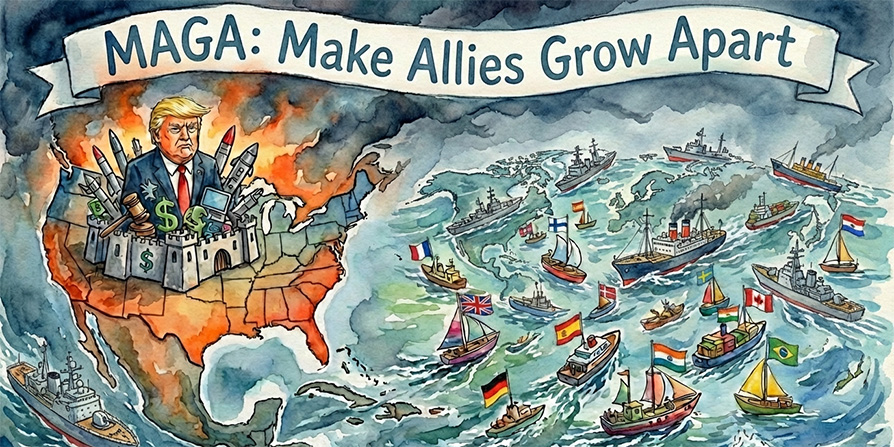
What Trump’s call as Make America Great Again is increasingly interpreted by allies and partners as Make Allies Grow Apart. Following Trump’s comments on Greenland, European leaders have adopted a more assertive stance toward the US economic aggression. Speaking on the sidelines of the World Economic Forum (WEF), French President Emanuel Macron warned that if Washington proceeds with its Greenland annexation agenda, Brussels will not hesitate to activate the ACI mechanism, which he famously described as a “trade bazooka”. While making clear that Europe will not yield to Trump’s demands, Macron also emphasized France’s and the EU’s readiness to pursue broad-based global cooperation across various blocs and countries, including China.
In line with that posture, the EU has concluded 25 years of long-stalled EU-Mercosur trade negotiations. Once ratified, the agreement will create a free trade zone encompassing more than 700 million people for its members. Europe also has outreach to Southeast Asian countries, with trade agreements concluded with Vietnam, Singapore, and Indonesia. Moreover, despite lingering fears of China’s industrial overcapacity, Brussels has re-engaged with Beijing to resolve trade frictions. The EU’s action reflects China’s continued indispensability as an economic partner amid the bloc’s economic turbulence.
A similar strategic recalibration is also evident in Canada, which has long relied on the US for economic stability and security guarantees. Repeated threats of trade tariffs from Trump and his provocative rhetoric aimed at making Canada the US’s 51st state have shattered the long-standing trust between the two countries. Canada has always been firm in its response to the US economic coercion, matching tariff threats with retaliatory tariff countermeasures. The WEF became the stage where tensions escalated. Prime Minister Mark Carney openly expressed that Ottawa is seeking distance from the US and is prepared to embrace the new international order grounded in rules rather than coercion.
Since taking office on 14th March 2025, Carney has rapidly diversified Canada’s economy and security partnerships. As he underscored in his remarks at Davos, Canada has signed 12 trade and security deals across four continents, including negotiations of strategic partnerships with China. Even though in the next few days after Davos, Carney announced Canada will not pursue free trade deal with China due to obligations under CUSMA (Canada-US-Mexico) trade agreement, Canada’s stance gives signal of a strategic shift to avoid overdependence on Washington.
On the other side of the world, the Southeast Asian (SEA) countries are gradually drifting apart from Washington. The 2024 ISEAS Yousuf Ishak survey to 1.994 respondents— comprising think tanks, government officials, academia, private sector representatives, civil society, NGO or media representatives, and regional or international organization personnel—across SEA captured a shifting outlook on strategic alignment. When asked if they are being forced to align their policy between the US and China, for the very first time since the survey was initiated, more than 50 percent of respondents identified Beijing as a strategic partner, rather than Washington. Although the results of the subsequent survey show that the US regained its ground in the region, the current trend shows the fragility of Washington’s leadership. A constant coercive economic policy that demands maximum concessions from the US will make SEA countries seek other partners and strengthen regional cooperation to reduce Washington’s influences.
China First
Trump’s policy to curb China’s economy increasingly looks ineffective, particularly given Beijing’s expanding trade surplus in 2025, despite US exports declining by 20 percent. According to China Customs Statistics, in 2025, Beijing year-on-year exports to the EU and SEA countries rose by 5,5 percent and 13,4 percent, respectively, while imports from 130 countries increased. This figure reflects the reality that the world still considers China an indispensable trading partner because of its competitiveness and market size.
While Trump negotiates with “guns” pointing to his partner’s heads, Beijing positions itself as champion and guardian of rule-based multilateralism, free trade, and global cooperations. As in Davos, Vice Premier He Lifeng said “On top of being the world’s factory, we hope to be the world’s market too.” The remarks express China’s willingness to address global economic imbalances and present itself as a reliable partner. The “Davos Moment”, where leaders express readiness to embrace a new global order is a symphony for Beijing.
The Possible New Global Order and How Indonesia Can Embrace It
What unfolded in Davos may ignite concrete actions by the rest of the world to reconstruct a new global order. While strategic economic diversification and security strengthening are already ongoing across every continent, a hawkish Washington will only accelerate the process. Regional blocs such as the EU are poised to take a proactive role on the global stage.
In this scenario, the US will undoubtedly remain an important actor in the global system, but its geopolitical dominance will likely erode. By hammering its own hegemonic pillars while squeezing others who don’t fit Washington’s interests, the US is shooting its own foot. Like a broken glass, the damage is beyond repair. As Amitav Acharya has argued, the world will forgive, but not forget. Washington is unlikely to regain the genuine trust of its allies and partners, even if the US try hard to restore the liberal order.
As for today, the options and opportunities for new and stronger partnerships are wide open for Indonesia, since the majority of the world is recalibrating geopolitical dynamics in the absence of a reliable Washington. Jakarta is well-positioned to deepen relations with other regional powers in the Indo-Pacific, as well as with Europe and the Middle East. Furthermore, the finalization of the Regional Comprehensive Economic Partnership (RCEP), the world’s largest trade group by GDP and population, will strengthen Indonesia and other members economic resilience as they navigate a multipolar global order.
In the current situation, Jakarta must craft well-calculated policies to capitalize on the changing world order. This begins with clear articulations of Indonesia’s core interests and a disciplined approach to effectively utilize limited resources. Therefore, Indonesia cannot be everything and everywhere to everyone, particularly when doing so may risk losing its relative autonomy and credibility. In this possible emergence of a new global order, Indonesia’s strength will not be driven by trying to be omnipresent, but by knowing what to choose, where to stand, and how to act.